In What Way Were the Abbasid Rulers Similar to the Roman Emperors?
AI 'resurrects' 54 Roman emperors, in stunningly lifelike images
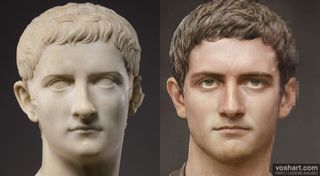
Ancient Roman emperors' faces take been brought to life in digital reconstructions; the unnervingly realistic epitome projection includes the Emperors Caligula, Nero and Hadrian, among others.
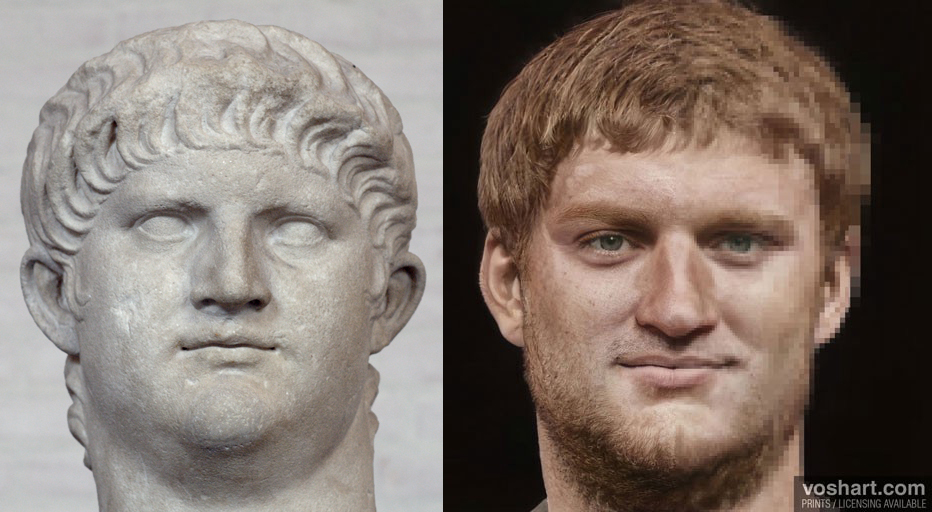
The features of these long-dead rulers have been preserved in hundreds of sculptures, only even the nearly detailed carvings can't convey what these men truly looked like when they were alive. To explore that, Canadian cinematographer and virtual reality designer Daniel Voshart used machine learning — reckoner algorithms that acquire through feel — in a neural network, a computing system processes data through hierarchies of nodes that communicate in a mode similar to neurons in a brain.
In the neural net, called Artbreeder, algorithms analyzed about 800 busts to model more realistic facial shapes, features, hair and skin, and to add together bright color. Voshart then fine-tuned Artbreeder's models using Photoshop, adding details gleaned from coins, artworks and written descriptions of the emperors from historical texts, to make the portraits actually come to life.
Related: Photos: The reconstruction of a teen who lived 9,000 years agone
"There is a rule of thumb in computer programming called 'garbage in garbage out,' and it applies to Artbreeder," Voshart told Live Science in an email. "A well-lit, well-sculpted bosom with little damage and standard face features is going to be quite easy to get a result." In dissimilarity, a dataset including damaged sculptures or ones photographed under poor lighting can produce proverbial "garbage" images that aren't very realistic.
The busts that Voshart preferred to use equally the chief sources were carved when their emperor subject was however alive, or were the most skillfully made, he said in a blog mail service.
For skin color, Voshart would either provide Artbreeder with a colorized reference paradigm, or let it "gauge" how to distribute hues so that the surface of the model resembled realistic man skin.
"I tin change skin tone and change ethnicity somewhat with transmission controls," he said.
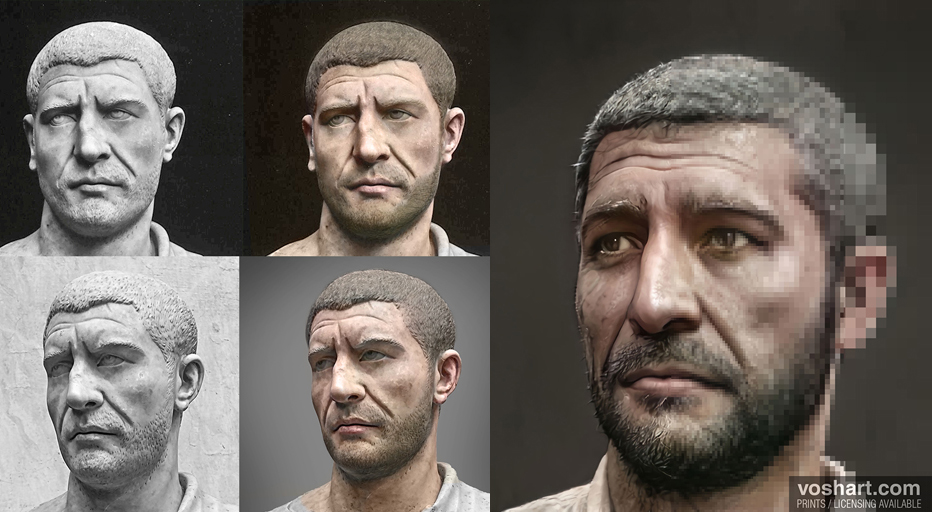
Tracking downwards all the fine art and reference text for the emperors took approximately 2 months, and assembling each portrait required most 15 to 16 hours on boilerplate, Voshart told Live Science.
For the emperor Caligula, who ruled from A.D. 37 to 41, Voshart adapted the Artbreeder model using descriptions that included "caput misshapen, eyes and temples sunken," and "eyes staring and with a glare savage enough to torture," from a newspaper titled "Personal Appearance in the Biography of the Roman Emperors," published in 1928 in the journal Studies in Philology.
Nero, emperor from A.D. 54 to 68, had a more rounded jaw, skin that was "freckled and repulsive," and a face that was "agreeable rather than attractive," according to the 1928 paper.
Related: The weird reason so many Roman emperors were assassinated
When Voshart began the Roman Emperor Project every bit a distraction during the COVID-xix quarantine, his noesis of the ancient emperors was "close to zero," he said. Still, what started as a diverting art experiment intrigued Voshart enough to eventually include 54 emperors, spanning a period in the Roman Empire that is sometimes called the Principate, from 27 B.C. to A.D. 285, he wrote on his website.
Knowing piddling well-nigh his subjects was actually a plus, allowing him to shape their faces without preconceptions or bias, Voshart said.
"In a forensic reconstruction, for instance, y'all only desire relevant information about hair, pare, known scars," and other physical features, Voshart explained. "Knowing aspects of personality can unduly influence an artist," leading them to arts and crafts a portrait that reflects a skewed perception of the discipline, he said.
You can see more than of Voshart's reconstructions on his website, and a affiche of the 54 faces in the Roman Emperor Project is bachelor at his Etsy shop.
Originally published on Alive Science.
Source: https://www.livescience.com/ai-roman-emperor-portraits.html
0 Response to "In What Way Were the Abbasid Rulers Similar to the Roman Emperors?"
Post a Comment